

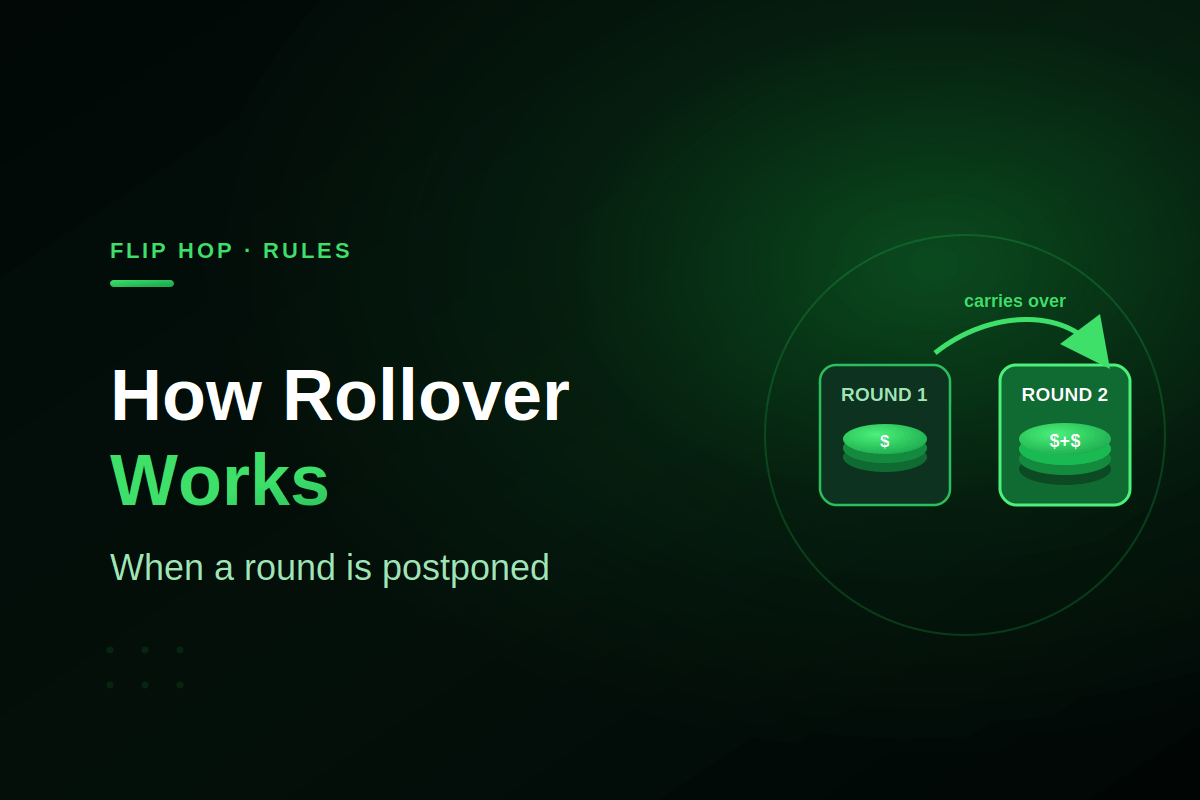
“Rollover” is a word that appears in Flip Hop’s rules in two different contexts — and it’s easy to confuse the two. This post explains each one clearly, shows how the calculations work in practice, and answers the most common questions about what happens to your tickets when a round doesn’t take place on the scheduled day.
Two Types of Rollover — Don’t Confuse Them
On Flip Hop, the word “rollover” describes two distinct mechanisms that have only one thing in common: “carrying something over to the next round”:
| Postponed-round rollover | 10%-of-the-pool rollover | |
| What it is | A round postponed for lack of a quorum | 10% of each round’s net pool |
| When it happens | Fewer than 5 unique wallets in the round | In every round that takes place normally |
| What carries over | The tickets bought move to the next day | 10% of the pool goes to the next round |
| Are my tickets valid? | ✅ Yes — they remain valid | — (doesn’t involve tickets directly) |
| Impact on the prize | The next round’s pool includes these tickets | Increases the next round’s prize |
| Who controls it | Automatic smart contract | Automatic smart contract |
The rest of this post explains each one in detail, with numerical examples.
Type 1 — Postponed-Round Rollover (the 5-wallet minimum not met)
The minimum-participants rule
Every Flip Hop round requires a minimum of 5 unique wallets participating for the drawing to happen. “Unique wallets” means distinct blockchain addresses — it doesn’t matter how many tickets a single wallet bought.
If at 00:00 UTC the round closes with fewer than 5 unique wallets, no drawing happens. The round is postponed — and all tickets bought that day automatically move to the next day’s round.
| The 5-wallet minimum rule exists to ensure that the drawing has real diversity of participants. A pool with 4 wallets would be statistically uncompetitive — and the platform prefers to postpone rather than run a drawing with minimal participation. |
What happens to your tickets in a postponed round
| Your tickets remain valid — automatically If you bought 3 tickets in a round that was postponed, those 3 tickets automatically move to the next round. You don’t need to do anything. You don’t lose the tickets, you don’t lose the amount paid, and you don’t have to buy again. The smart contract keeps your participation record and includes it in the next eligible round. |
The next round starts with the postponed round’s tickets already counted. New participants can buy tickets that day — and everyone competes together once the 5-wallet minimum is reached.
Practical Example — a Postponed Round
| Day 1 (round postponed — 4 unique wallets) | Value |
| Unique wallets with tickets | 4 |
| Required minimum | 5 |
| Does the drawing happen? | ❌ No |
| Tickets valid for Day 2? | ✅ All of them |
| Accumulated pool (e.g., 20 tickets × $5) | $100 |
| Day 2 (round takes place — 6 unique wallets) | Value |
| Day 1 tickets (carried over) | 20 tickets |
| New tickets bought on Day 2 | 15 tickets |
| Total tickets in the round | 35 tickets |
| Total unique wallets | 6 wallets |
| Gross pool (35 × $5) | $175 |
| Net pool (less affiliate commissions) | ~$170 |
| Winner’s prize (60%) | ~$102 |
| Platform (30%) | ~$51 |
| 10% rollover → Day 3 | ~$17 |
| How many days can it be postponed? The round keeps getting postponed — accumulating tickets — until at least 5 unique wallets participate. There’s no maximum number of postponement days defined in the rules. The drawing happens on the first day the minimum is met. |
Type 2 — 10%-of-the-Pool Rollover (in Every Normal Round)
What the 10% rollover is
Even when a round takes place normally — with 5 or more unique wallets and a completed drawing — 10% of the net pool goes neither to the winner nor to the platform. It’s set aside and automatically transferred to the next round.
This creates a progressive accumulation effect: every round that goes by adds 10% of its pool to the next one’s prize. This rollover is added to the next round’s pool even before any ticket is sold.
How the 10% rollover accumulates
| Round 1 (e.g., 30 tickets sold) | Value |
| Gross pool (30 × $5) | $150 |
| Net pool (gross pool – affiliate commissions) | $147 |
| Winner’s prize (60%) | $88.20 |
| Platform (30%) | $44.10 |
| Rollover to R2 (10%) | $14.70 |
| Round 2 (e.g., 25 tickets sold + $15 rollover) | Value |
| Gross pool (25 × $5) | $125 |
| Net pool (gross pool – affiliate commissions) | $122 |
| Rollover received from R1 | +$14.70 |
| Effective pool for distribution | $136.70 |
| Winner’s prize (60% of the effective pool) | $82.02 |
| Platform (30% of the effective pool) | $41.01 |
| Rollover to R3 (10%) | $13.67 |
The values above are estimates to illustrate the mechanics. The exact values of each round depend on the actual net pool (after affiliate commissions). The smart contract performs this calculation automatically.
| The 10% rollover is what allows the prize of a round with few tickets to be disproportionately larger than that round’s gross pool would suggest. It’s the accumulation from the previous round inflating the current prize. |
Frequently Asked Questions About Rollover and Postponed Rounds
If the round is postponed, when do my tickets expire?
Your tickets don’t expire. They stay valid indefinitely until the 5-wallet minimum is reached and the drawing happens. It could be the next day, it could be in two days, it could be longer — the contract waits for the quorum.
Can I buy more tickets while the round is postponed?
Yes. You can buy additional tickets while a round is accumulating participants. All the tickets — those bought on the day of the first close and the new ones — compete together in the same round when the drawing finally happens.
Is the 10% rollover deducted from my prize if I win?
No. If you win, you receive 60% of that round’s “effective” pool, as shown in the example in the previous table.
Note: You can check the distribution of the round’s values under “round transparency” on the fliphop.club homepage or in your dashboard.
Can the accumulated rollover be withdrawn by the platform?
No. The rollover is managed by the smart contract — and the contract has no function that lets the platform move that balance arbitrarily. It can only be distributed as part of the prize of an eligible round, according to the rules programmed into the contract. You can verify this by reading the contract’s source code on Basescan.
Summary — Understanding Rollover in 4 Lines
| Rollover rules — quick reference | Value |
| Minimum unique wallets for a drawing | 5 wallets |
| What happens to postponed-round tickets | They carry over to the next day |
| % of the pool that goes to the next round | 10% of the net pool |
| Who executes the rollover | The smart contract — automatic |
| Can rollover be canceled or withdrawn by the platform | ❌ No |
| Do tickets expire if the round is postponed | ❌ No — they stay valid |
| Does rollover inflate the next round’s prize | ✅ Yes |
Rollover Is the Mechanism That Makes the Prize Grow on Its Own
The 10% rollover is one of the most elegant features of the Flip Hop model: each round feeds the next, and no one needs to do anything for it to happen. The contract automatically ensures that part of today’s value is kept for tomorrow — and that your tickets are never wasted for lack of a quorum.