

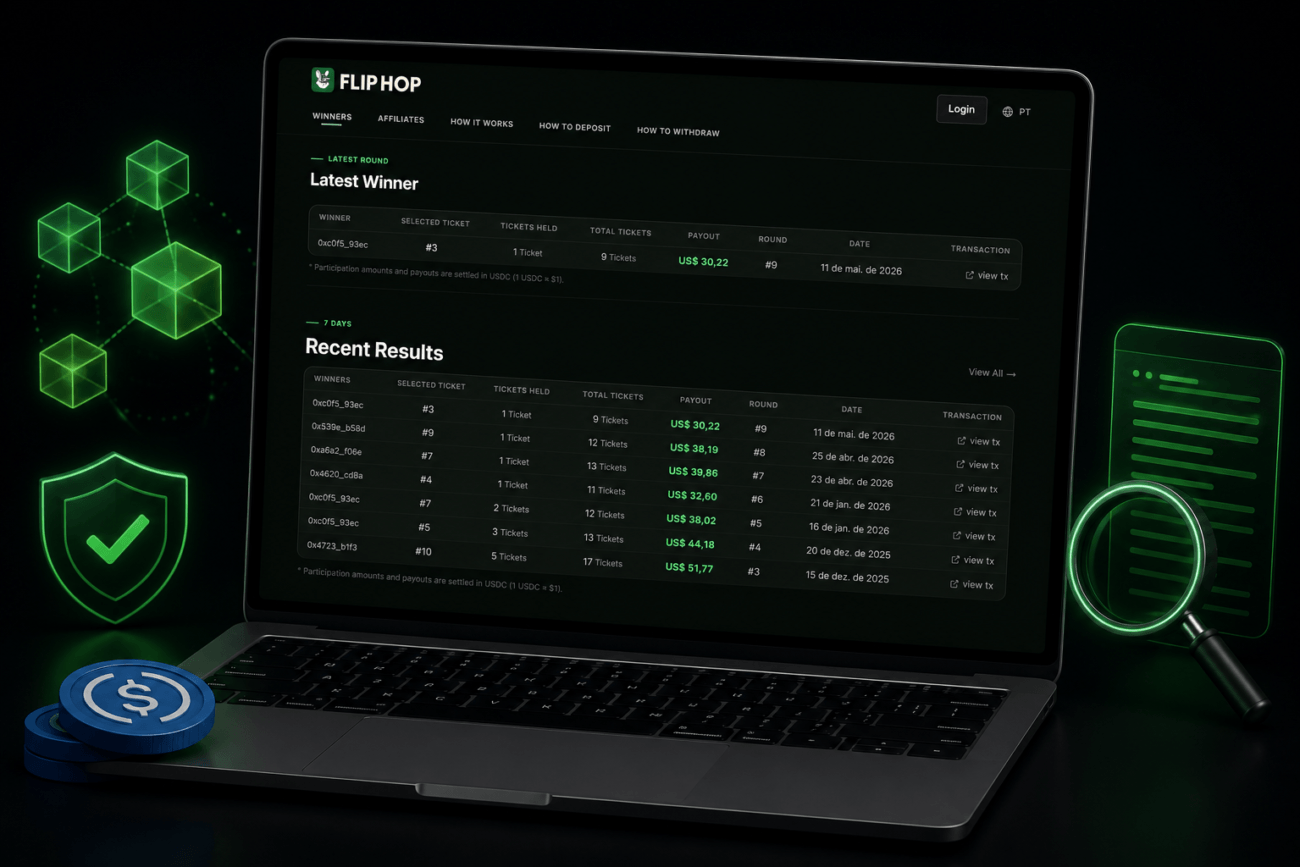
One of the key features of Flip Hop is that its core activity happens on the blockchain — meaning it’s not just visible inside the platform, it’s independently verifiable by anyone. Here’s what that means in practice.
What Does “On-Chain” Mean?
When something is “on-chain,” it means it’s recorded directly on a blockchain — a decentralized, public ledger that anyone can read. Unlike traditional platforms where activity lives inside a private database, on-chain records are:
- Public — anyone can view them
- Immutable — they cannot be altered after the fact
- Independently verifiable — you don’t need to trust the platform’s word
What Is Recorded On-Chain on Flip Hop?
Relevant platform activity is supported by blockchain-connected infrastructure. This includes:
- Smart contract logic — the rules that govern how rounds work
- Round activity — ticket purchases and participation records
- Payout transactions — when and how winnings are distributed
This means the core mechanics of Flip Hop — how rounds run, who participates, and how payouts happen — are not hidden inside a black box.
What Is a Smart Contract?
A smart contract is a self-executing program stored on the blockchain. It runs automatically when certain conditions are met — no human intervention required.
On Flip Hop, the smart contract governs key platform logic, such as how the prize pool is calculated and how payouts are triggered. Because the contract lives on the blockchain, its code is publicly accessible and its execution is verifiable.
What Network Does Flip Hop Use?
Flip Hop is built on the Base network, an Ethereum-based blockchain developed by Coinbase. Base is designed for speed, low fees, and reliability — and all on-chain activity on Flip Hop runs through it.
How Can I Verify Activity Myself?
You can verify Flip Hop’s on-chain activity directly through the blockchain explorer. From the platform, you can access:
- View Contract — to inspect the smart contract code and logic
- View Transactions — to see a record of round activity and payouts
No special tools or technical knowledge are required to browse the explorer — it’s publicly accessible to anyone.
Does On-Chain Transparency Mean Everything Is Audited?
Not necessarily. On-chain transparency means that relevant activity is publicly visible and verifiable — but it doesn’t automatically mean every component has undergone a formal third-party security audit. Flip Hop treats audit readiness as an important part of responsible platform development, and independent review processes are part of its ongoing approach.
Why Does This Matter for Users?
It means you can verify what happened in a round without relying solely on Flip Hop’s dashboard. The blockchain record is the source of truth — and it’s accessible to you at any time.